 Find the Latest Jobs in UAE, Qatar, Saudi Arabia & the Gulf Region
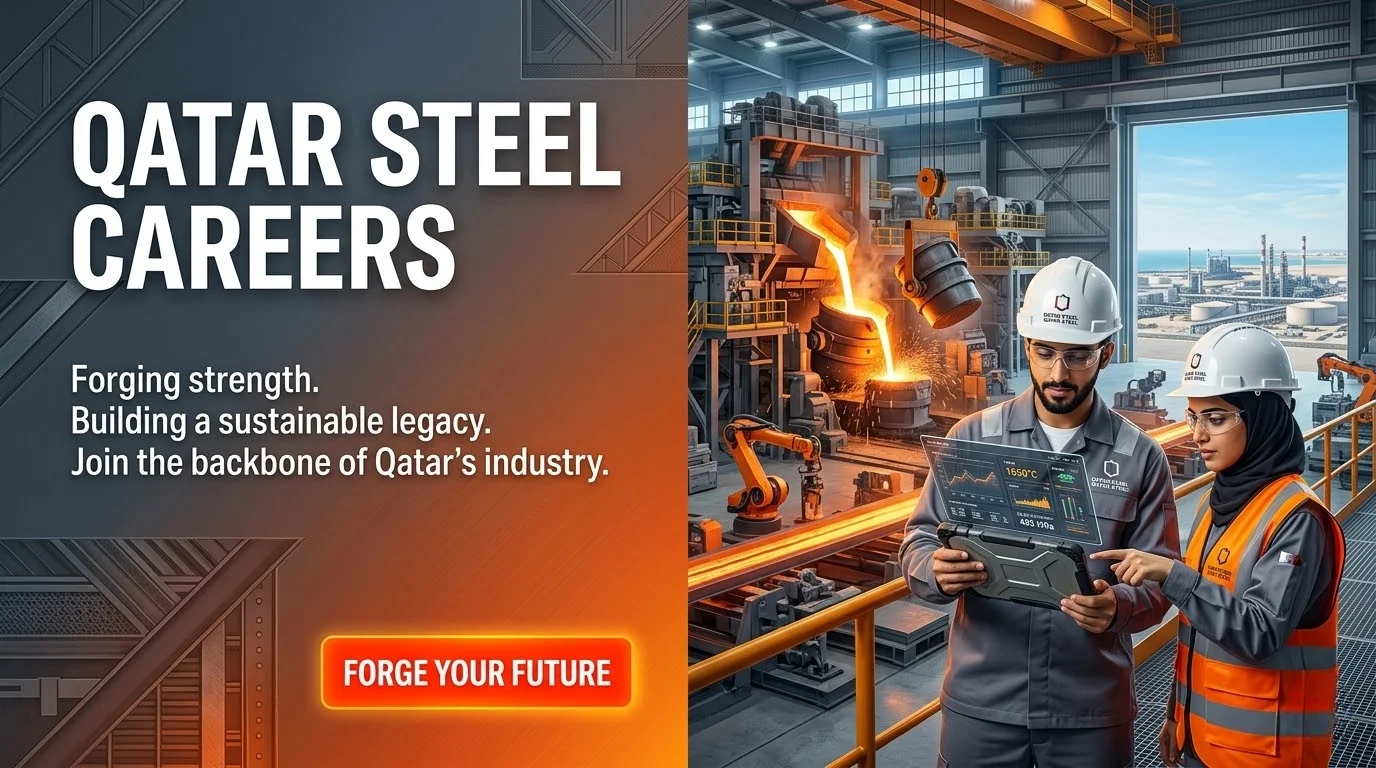
Driving south of Doha into Mesaieed Industrial City brings you face-to-face with the intense reality of heavy manufacturing. Because this massive facility produces millions of tons of rebars and iron billets annually to feed the country’s ongoing construction boom, ambitious engineers and technicians constantly monitor Qatar Steel Careers for a chance to break into the region’s elite heavy industry sector.
But let us be completely honest about what it means to work inside a steel plant. It is arguably one of the most physically punishing and high-risk environments on earth.
You are dealing with molten metal reaching thousands of degrees, the deafening roar of Electric Arc Furnaces (EAF), and the suffocating humidity of the Qatari summer. It is a highly hazardous zone where a single lapse in concentration or failure to wear specialized protective gear can lead to severe accidents.
However, surviving this brutal environment comes with massive financial and lifestyle rewards. As a heavily state-backed entity operating under the umbrella of Industries Qatar, the company provides unparalleled long-term job security. Permanent staff receive tax-free salaries, heavily subsidized compound housing in Al Wakrah or Mesaieed, comprehensive global medical insurance, and highly generous education allowances for expat families.
If you have the extreme physical endurance and technical discipline required for heavy metallurgy, here is an unfiltered look at the 2026 industrial salary scales, the relentless plant floor conditions, and how to actually get your CV through their strict engineering filters.
Advertisement
The Qatar Steel Hiring Radar (2026 SitRep)
Advertisement
- Hiring Speed: Slow and highly calculated. Because plant safety is critical, the technical assessments, panel interviews, and strict medical clearances can take anywhere from 3 to 5 months.
- Visa Sponsorship: 100% direct company sponsorship for core staff. They offer comprehensive relocation packages, handling your Qatar ID, flights, and initial settlement in Mesaieed.
- Biggest Dealbreaker: Occupational Health & Heat Tolerance. The medical fitness test for steel plant workers is brutal. If your pre-employment medical shows underlying lung issues, high blood pressure, or a poor BMI that makes you susceptible to heat stroke, your offer will be revoked instantly.
Advertisement
2026 Salary Guide: What Do Heavy Industrial Jobs Pay?
Note: The salaries below reflect the standard 2026 heavy manufacturing market in Qatari Riyals (QAR). Expat packages vary greatly based on your level of technical specialization, whether you work a shift pattern, and your global mobility tier.
| Role | Demand Level | Est. Monthly Salary (QAR) | Core Benefit |
| Plant / Production Manager | Medium | 30,000 – 45,000+ QAR | Family Education Allowance |
| Metallurgical Engineer | High | 15,000 – 25,000 QAR | Premium Housing Allowance |
| HSE / Safety Supervisor | Very High | 12,000 – 18,000 QAR | Yearly Flight Tickets |
| Mechanical Technician | Very High | 5,000 – 8,000 QAR | Shift & Hazard Allowances |
| Overhead Crane Operator | High | 4,000 – 6,000 QAR | Company Transport & Meals |
| Heavy Rigger / Helper | Very High | 1,800 – 2,500 QAR | Fully Furnished Labor Camp |
Which Operational Division Demands Your Expertise?
A fully integrated steel mill dictates a ruthlessly segregated operational workforce. You do not casually cross from the climate-controlled administrative blocks into a live rolling mill without a hard hat and an authorized Permit to Work (PTW) clearance. Here is the unfiltered operational reality inside their three primary tactical zones:
Melting & Casting (The Liquid Fire Frontline)
- Targeted Deployments: Furnace Commanders, Casting Crew, and DRI Operators.
- The Ground Reality: If deployed to the furnace or casting grid, you are operating directly adjacent to rivers of liquid fire. Your operational cycle dictates mitigating extreme thermal exposure while manipulating heavy industrial machinery to melt raw scrap and direct reduced iron into solid billets. The physiological toll is absolute, particularly during grueling 12-hour summer rotations.
- The Prime Operator: Calloused, heat-resilient grapplers. Operations directors exclusively headhunt incredibly tough individuals who already carry years of heavy, verified exposure in steel, aluminum, or foundry environments.
Plant Maintenance & Engineering (The Mechanical Backbone)
- Targeted Deployments: Heavy Mechanical Technicians, High-Voltage Electricians, and Millwrights.
- The Ground Reality: The maintenance operatives are the physiological lifeblood of continuous plant production. Your deployment drops you into climbing massive overhead cranes, extracting heavy conveyor belts, or neutralizing high-voltage panels coated in thick, conductive metallic dust. Because a singular equipment failure cripples a multi-million-dollar production line, the pressure is immense.
- The Prime Operator: Battle-tested technical tacticians. The HR directorate aggressively targets candidates armed with formal ITI diplomas and years of hands-on, rapid-fire troubleshooting experience within heavy industrial manufacturing.
Health, Safety & Environment (The Watchdogs)
- Targeted Deployments: HSE Auditors, Safety Officers, and LOTO Controllers.
- The Ground Reality: Commanding safety in a steel mill means enforcing absolute compliance in one of the planet’s most dangerous operational theaters. You will relentlessly patrol the rolling mills and blast furnaces, interrogating operatives to guarantee strict adherence to heat-resistant PPE and uncompromising Lockout/Tagout (LOTO) protocols for kinetic machinery.
- The Prime Operator: Uncompromising regulatory enforcers. Plant commanders highly favor authoritative professionals wielding elite NEBOSH diplomas and a proven, heavy-industrial incident prevention background. They require operatives who possess the absolute authority and nerve to instantly shut down a live site if a fatal risk is detected.
Hiring Now: What It Takes to Be a Mechanical Technician
Because the massive rolling mills and conveyors run 24/7, the equipment suffers extreme wear and tear. Qatar Steel is constantly recruiting highly skilled technicians to prevent unexpected mechanical failures. Here is exactly what the maintenance supervisors demand right now (as highlighted in our schema data):
What You Actually Need (Requirements):
- A formal ITI (Industrial Training Institute) Diploma or an Associate Degree in Mechanical Engineering.
- At least 3 to 5 years of hands-on maintenance experience inside a heavy steel plant, cement factory, or major petrochemical facility.
- Deep technical knowledge of heavy hydraulics, pneumatics, rotating equipment, and large-scale gearboxes.
Your Daily Reality (Responsibilities):
- You will perform rigorous preventative maintenance on massive rolling mills, overhead cranes, and cooling towers to ensure zero unplanned downtime.
- You must accurately align heavy motors, replace massive industrial bearings, and troubleshoot complex hydraulic fluid systems covered in grease and metallic dust.
- You will log all repairs, spare parts used, and equipment conditions into the corporate SAP Plant Maintenance (PM) module at the end of every shift.
The 3-Step Strategy to Get Hired
Do not try to drop a paper CV at the Mesaieed security gate; it is a restricted industrial zone. You need to use targeted digital and networking tactics to land steel plant jobs in Qatar.
Step 1: The Corporate ATS Portal (For Direct Hire)
Qatar Steel utilizes a strict digital recruitment system for its permanent engineering and technical staff.
- The Action: Create a highly detailed profile directly on the Qatar Steel careers portal. Their Applicant Tracking System (ATS) aggressively filters out generic resumes. You must inject hard industrial keywords into your CV. Use exact terminology like “Predictive Maintenance”, “Vibration Analysis”, and “SAP PM Execution” to successfully pass the automated screening bots.
Step 2: Approved EPC & Maintenance Contractors (The Backdoor)
If you cannot secure a direct corporate role, get onto the plant floor as an outsourced contractor. Qatar Steel uses massive engineering firms to handle their heavy maintenance turnarounds.
- The Action: Register your profile with major GCC industrial contractors like Descon Engineering, Galfar Al Misnad, or Madina Group. These companies hold massive contracts to supply specialized technicians to Mesaieed. Working as a contractor is the absolute best way to prove your grit on the plant floor and network your way into a direct Qatar Steel contract later.
Step 3: The Direct LinkedIn Pitch (For Senior Engineers)
If you are currently working for a massive regional competitor like Emirates Steel or Hadeed SABIC, bypass the HR portal entirely and speak to the plant leadership.
- The Action: Search LinkedIn for titles like “Maintenance Manager Qatar Steel” or “Lead Mechanical Engineer Mesaieed”.
- The Message: Keep it completely metric-driven and technical. “Hi [Name], I am a Mechanical Maintenance Engineer with 6 years of heavy steel experience, recently leading a major rolling mill turnaround ahead of schedule. I am looking to transition my career to Doha. Are you currently reviewing CVs for the upcoming plant maintenance cycles?”
Advertisement
Advertisement
